
Driving in Grand Cayman: Rules to Know Before You Arrive
Driving in Grand Cayman 2026: Rules, Tips, and What to Know Before You Rent a Car
Updated. May 7 2026
In Grand Cayman, you drive on the left side of the road. Visitors from the US, Canada, and the UK can drive legally on their home license for up to six months without a separate local permit. Speed limits are posted in miles per hour. The roads are flat, well-maintained, and easy to learn. Most first-timers feel confident within a few hours. Renting a car is the best way to reach the East End, Rum Point, and the island’s most stunning beaches on your own schedule.
If you’ve been Googling “driving in Grand Cayman” with a knot in your stomach, take a breath. You can do this. The island is small, the roads are manageable, and local drivers give rental cars plenty of patience.
Driving in Grand Cayman is one of the most freeing things you can do on vacation here. It opens up beaches, viewpoints, and restaurants that tour buses simply don’t reach.
This guide covers everything you need before you get behind the wheel: the rules of the road, how the visitor permit works, which car rental companies to consider, and how to figure out if you even need a car at all.
By the time you finish reading, you’ll feel ready to drive on day one.
How Do You Drive Legally in Grand Cayman as a Visitor?
You can drive in Grand Cayman with your home country’s valid driver’s licence without obtaining a local permit, provided you have proper insurance coverage.
Visitors from convention countries (including the US, UK, and Canada) can drive for up to 6 months, while those from non-convention countries can drive for 1 month. Stays longer than one month require a local permit from the Cayman Islands Department of Vehicles and Drivers’ Licensing (DVDL). Though most vacation visitors won’t come close to that threshold.
The minimum driving age for visitors is 18 years, although residents can obtain a licence at 17.
Here are a few things you should keep in mind before getting behind the wheel:
Your licence must be current and in good standing.
You’ll need valid insurance coverage, either through your personal policy, credit card coverage, or the rental agency’s options.
Most rental companies require drivers to be at least 21 years old, and some apply a surcharge for drivers under 25.
You’re restricted to vehicle classes matching your home license (e.g., private cars, light trucks, and motorcycles under 125cc).
Keep both your driving licence and insurance documentation with you at all times when driving.
Which Side of the Road Do You Drive On in Grand Cayman?
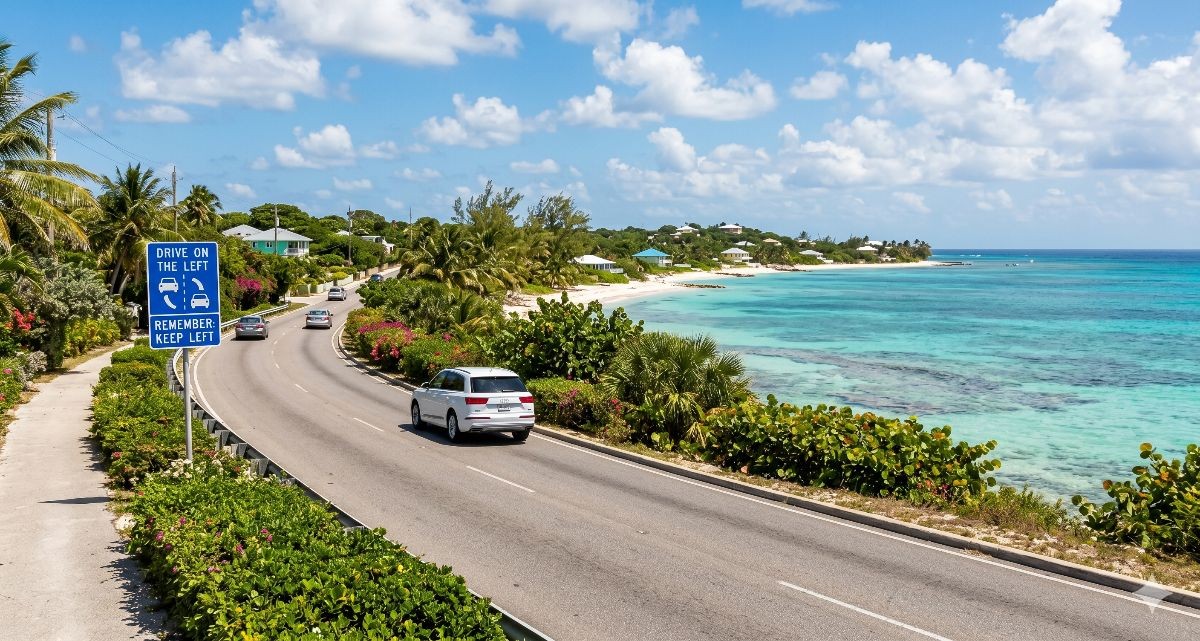
Grand Cayman follows left-hand traffic, meaning you’ll drive on the left side of the road with the steering wheel typically on the right side of the vehicle.
As a British Overseas Territory, the Cayman Islands aligns with UK driving conventions. If you’re visiting from the US, Canada, or any other right-hand-traffic country, this is the one adjustment that requires your full attention on day one.
The reassuring part? You’re on a compact island with mostly single or dual-lane roads, light traffic outside of George Town during rush hour, and zero highway interchanges. There are no six-lane motorways to navigate here.
What to Expect Your First Day Behind the Wheel
Your instinct will be to drift toward the right, especially in quiet parking lots or at empty intersections. Here are a few mental tricks that help first-timers stay on track:
Repeat “left, left, left” every time you exit a parking lot or driveway
Hug the centre line on your right as your positioning anchor
Turn right into the lane closest to the left curb.
Go slow through your first few roundabouts. They’re the steepest part of the learning curve
We advise that you take it slow during those first few hours. Rental vehicles carry white license plates in Grand Cayman, while locally registered vehicles have yellow plates. The rental car’s white licence plates actually work in your favour because local drivers recognise these plates and give rental vehicles extra space and patience, particularly around roundabouts.
What are the Essential Driving Rules in Grand Cayman?
Grand Cayman traffic law draws from British convention with a few local additions. These are the rules that will affect your day-to-day driving.
Speed Limits
Speed limits in Grand Cayman are posted in miles per hour—unusual for a British territory, but that’s how it works here. The signs are circular, have a red outline, and are easy to spot on the roadside.
Zone
Speed Limit
School zone (amber lights flashing)
15 mph
Residential and urban streets
25 to 30 mph
Main connecting roads
40 mph
Highway
50 mph
School zone enforcement is no joke. Any driver caught exceeding 30 mph in a 15 mph school zone faces a license suspension of 6 to 12 months. Slow down the moment you see those amber lights, full stop.
The Police issue speeding tickets freely. Watching your speed isn’t just about safety; it’s also about protecting your wallet. The fines add up quickly, and nobody wants to spend their holiday budget on traffic violations.
Roundabouts
Grand Cayman has over two dozen roundabouts, and several of them are three-lane. They replace most traffic lights across the island, so you’ll be using them constantly.
The core rule: yield to traffic already in the roundabout, approaching from your right. Here’s how to handle them cleanly:
Left lane for the first or second exit
Centre or right lane for later exits
Signal before exiting and check your left blind spot before moving to the outer lane
Never stop suddenly once you’re inside the roundabout
If you want to practice before you arrive, the Cayman Islands Department of Transport has a short YouTube video tutorial covering roundabout rules specifically for visitors. Watch it—it’s five minutes well spent.
Other Key Rules for Driving in Grand Cayman
Here are other critical rules that’ll keep you legal and safe:
Using a mobile phone while driving is illegal, unless you’re using a hands-free device. Violating this rule attracts a fine of CI$150
Seatbelts are required for all passengers, both front and back
Children under two must be secured in rear-facing car seats (never in seats with front airbags).
You can turn left at red lights after coming to a complete stop, unless signage indicates otherwise.
Pedestrians always have the right of way at crossings.
Fog lights are illegal during normal driving conditions, so ensure they’re switched off.
When a school bus has flashing lights and stops to let children on or off, you cannot pass from either direction.
The centre turning lane on some roads exists to help drivers turn or merge, never for overtaking.
The legal blood alcohol limit is 0.07%, and violations result in a 12-month driving disqualification plus CI$1,000 fines or six months imprisonment
What are the Best Car Rental Companies in Grand Cayman?
Renting a car in Grand Cayman is a smooth process. You can collect your vehicle at Owen Roberts International Airport (GCM) or arrange delivery to your vacation rental property. If you’d prefer a private transfer upon arrival, our airport transfer page covers all the options.
Local Rental Companies
Local agencies are well-established on the island and often offer competitive rates with personable service:
Andy’s Rent-a-Car: One of Grand Cayman’s most recognised local agencies. They have a wide selection of vehicles and staff who know the island well.
Coconut Car Rentals: Popular with repeat visitors for a reliable fleet and a no-fuss rental process.
Cayman Auto Rentals: Another strong local option with airport pick-up available.
International Rental Chains
If you prefer booking through a familiar platform or earning loyalty points, major chains operate here too:
Avis: Available at the airport with full online booking.
Budget: Competitive pricing, particularly for weekly rentals.
Hertz: Reliable standard fleet with international coverage options.
What to Budget For
Here’s what to factor into your trip costs when you rent a car in Grand Cayman:
Daily rates: Economy vehicles run approximately CI$50 to CI$90/day, depending on season and availability.
Insurance: A collision damage waiver (CDW) is usually available at the rental counter. Check your credit card benefits before your trip because many cards include CDW for international rentals.
Fuel: Expect to pay CI$4.83–6.08 per imperial gallon (roughly USD $5.80–7.30) for regular gasoline, with premiums up to CI$6.03 and diesel around CI$5.30–5.62. Prices vary by self-serve or full-serve and station. Check the latest fuel prices on the Office for Utility Regulation (OfReg) website.
Note: an imperial gallon is about 20% larger than a US gallon, so the per-fill cost will feel higher than the per-gallon rate suggests.
Vehicle type: A standard sedan handles the main roads comfortably. If you’re spending time on East End back roads or North Side tracks after heavy rain, an SUV is worth the upgrade.
What Should You Know About Parking in Grand Cayman?
Parking is one of the pleasures of driving in Grand Cayman. It’s not the stressful experience visitors expect.
Free Parking Around the Island
Public parking is free at most beaches, parks, and tourist attractions. Seven Mile Beach has multiple public access points with grassy parking areas directly across the road from the water. Rum Point has a free dedicated lot right at the beach.
Spots at popular East End and North Side destinations like Starfish Point, Governor’s Beach, and Kaibo Beach sell out quickly on busy days during peak season (December through April). Arriving by 9 a.m. keeps your options open.
Parking in George Town
George Town has street parking on most central streets, but availability tightens during business hours and on cruise ship days when many day visitors arrive between 8 a.m. and 4 p.m.
A few practical tips for town parking:
Use the public car parks near the waterfront on Cardinal Avenue for the most reliable availability
Check every sign before you walk away. Some spots restrict parking during specific hours or reserve spaces for commercial deliveries
Never block a private driveway, even for a few minutes, as tow trucks do operate in the area, and response is quick
Resort and Beach Parking
Some resort properties limit parking in their lots to registered guests. Public beach access points always have alternative parking nearby, so use those rather than risking a private lot.
How Do You Find Your Way Around Grand Cayman?
It’s difficult to get lost in Grand Cayman. The island is 22 miles long and 8 miles wide. There are a limited number of main roads, and most of them eventually loop back toward the West Bay Road corridor or Frank Sound Road.
Does Google Maps Work in Grand Cayman?
Yes, Google Maps works well throughout most of Grand Cayman and is accurate for turn-by-turn navigation. It handles roundabouts correctly and covers the full road network. Download offline maps for Grand Cayman before your flight so navigation still works when the cell signal is weak in the East End or North Side.
Apple Maps is functional and has improved significantly for island coverage. Waze works here too, though it’s better suited for monitoring traffic flow in George Town than for basic route-finding on an island this size.
Key Road Corridors to Know
Getting your bearings is easy once you know three routes:
West Bay Road runs along Seven Mile Beach and connects Owen Roberts Airport to George Town and the north. This is the main artery you’ll use most.
Frank Sound Road cuts across the island’s interior and is the main route out to the East End. You can spend 30-40 minutes from George Town.
Rum Point Drive follows the north coast up to Rum Point, Starfish Point, and Cayman Kai.
Almost every destination on the island is within 40 minutes of George Town. The East End feels remote, but it’s not actually far.
Fuel Station Coverage
Fuel stations are concentrated around George Town and the West Bay area. If you’re spending the day on the East End or North Side, fill up before you head out. Running low on that side of the island will add an inconvenient backtrack. The OfReg fuel price page shows current prices at every station, so you can compare before you stop.
Do You Need to Rent a Car in Grand Cayman?
The honest answer: it depends entirely on where you’re staying and what you want to do. Let’s simplify your options:
Areas Where a Car is Essential
Some parts of Grand Cayman simply aren’t accessible on foot, by taxi on a budget, or by public bus:
East End: No public transit serves this area. Taxis from George Town are expensive for daily trips. If your rental property is in places like Morritt’s Tortuga Club, The Cottages in East End, or Northern Lights, a rental car is non-negotiable.
Rum Point and Cayman Kai: Getting to Rum Point and Starfish Point without a car is impractical. A rental car lets you head up early, beat the boat tours, and leave on your own schedule.
North Side properties: It is remote, beautiful, and best explored with your own wheels.
Areas Where You Can Manage Without a Car
Seven Mile Beach: If you’re staying along the beach strip and plan to spend most of your time at the water, in beachfront restaurants, and on organised tours, you can manage without a car. Taxis are readily available, and the CI: GO app lets you calculate fares in advance.
George Town itself: It is walkable for most of what a short-stay visitor needs, including the port area, duty-free shopping, and ferry connections.
Transportation Alternatives
If you’d rather skip the rental or just need a smooth airport arrival:
Use private airport transfers if you’re arriving with luggage and want a stress-free start. Book this alongside your property.
Taxis: Available at the airport and outside major hotels. Fares are regulated but not cheap for longer distances.
Public buses: Routes run along West Bay Road and Bodden Town Road, but coverage is limited, and schedules are not geared toward tourist attractions beyond George Town and Seven Mile Beach.
Scooters and bicycles: Available through local rental operators. A fun option for short trips along Seven Mile Beach, but less practical for cross-island travel.
The bottom line is simple: if you want to explore Grand Cayman’s beaches beyond the Seven Mile strip, visit Rum Point, or stay in any East End or North Side property, rent a car. The flexibility is worth every penny.
What Should You Do in a Driving Emergency?
Ensure you dial 911 for police, fire, or medical emergencies, and keep your rental agency’s roadside assistance number accessible.
Keep this emergency contact list nearby:
Emergency services: 911 connects you to police, fire, and medical response.
Royal Cayman Islands Police Service (RCIPS): Contact for non-emergency situations or accident reporting.
Roadside assistance: Your rental agency provides this service, so save their number in your phone when you collect the car.
The law requires that in accidents involving injury to people, animals, or property, you must exchange names, addresses, dates of birth, registration numbers, and insurance details, or report the accident to the police within 24 hours.
If you’re involved in a minor accident, move your vehicle to the side of the road if it’s safe to do so and wait for the police to arrive. Take photos of any damage and exchange information with other parties involved. Never admit fault at the scene.
Get out there and See the Real Grand Cayman
Driving in Grand Cayman offers the freedom to discover hidden beaches, breathtaking coastal views, and authentic local spots at your own pace. The well-maintained roads and stunning scenery make it enjoyable once you’ve adjusted to driving on the left-hand side of the road.
To learn more about Grand Cayman, be sure to visit the official Cayman Islands tourism board website. If you haven’t booked your accommodation yet, check out our Grand Cayman vacation rentals page to find the one you love.
Frequently Asked Questions About Driving in Grand Cayman
Can I drive in Grand Cayman with a US or Canadian licence?
Yes, your valid US or Canadian driver’s licence allows you to drive in Grand Cayman for up to six months without obtaining a local permit. You must be at least 18 years old and carry valid insurance coverage.
How long does it take to drive around Grand Cayman?
Driving the complete island circuit takes approximately two hours without stops. The island measures 22 miles long and 8 miles wide, making it perfect for full-day exploration when you factor in stops at beaches, restaurants, and viewpoints.
Are there toll roads in Grand Cayman?
No, all roads in Grand Cayman are free to use. You won’t encounter any toll booths or road pricing systems anywhere on the island.
Is it difficult to adjust to driving on the left side?
Most visitors adapt within a few hours, particularly if they are driving a right-hand-drive vehicle. The trickiest moments occur at roundabouts and turns, but local drivers recognise rental car plates (white) and typically give you extra space and patience.
How much does it cost to rent a car in Grand Cayman?
Car rentals in Grand Cayman typically cost $25–$60 USD per day for economy cars.
Prices average around $49 per day but drop to $16–$25 in the low season (October) and rise to $60+ during peak months like March.
Is it safe to drive in Grand Cayman at night?
Yes, nighttime driving in Grand Cayman is generally safe. Main roads are well-lit, and crime rates on the island are low. Use extra caution on rural East End and North Side roads where lighting is sparse, and wildlife occasionally crosses after dark.